 patternihaandClaude Opus 5.5
edd916b08e
patternihaandClaude Opus 5.5
edd916b08e
With strictRoute, only port 53 was kept inside the TUN. But Windows' DNS
Client service sends the queries for an interface's DNS servers out
through that interface, whatever the routes say, and since Windows 11
and Server 2022 it may send them over HTTPS or TLS, when that is set up
for the interface (as Windows Settings does) or for the server. Those
left through the physical link.

On those versions, the DNS Client service may now only connect through
the TUN, except for its mDNS and LLMNR. The filters recognize the
service by its SID in the token of its process, as Windows Firewall's
own rules for it do. Earlier versions only query port 53, and may run
the service in one process with others, so they get no such filters.
The port 53 rule stays, for the programs that query a resolver on the
local network themselves, and for those earlier versions.

Tested on Windows 11, elevated: with DoH set on Wi-Fi per adapter, per
network profile or by global auto-upgrade, none of the DNS Client's
connections left through Wi-Fi (WFP logged the drops by the new filter),
names still resolved through the TUN, mDNS and LLMNR still went out, and
other programs were unaffected, also in a real Xray run.

Co-Authored-By: Claude Opus 5.5 <noreply@anthropic.com>
Project X
Project X originates from XTLS protocol, providing a set of network tools such as Xray-core and REALITY.
README is open, so feel free to submit your project here.
Sponsors
Donation & NFTs
Collect a Project X NFT to support the development of Project X!

- TRX(Tron)/USDT/USDC:
TNrDh5VSfwd4RPrwsohr6poyNTfFefNYan - TON:
UQApeV-u2gm43aC1uP76xAC1m6vCylstaN1gpfBmre_5IyTH - BTC:
1JpqcziZZuqv3QQJhZGNGBVdCBrGgkL6cT - XMR:
4ABHQZ3yJZkBnLoqiKvb3f8eqUnX4iMPb6wdant5ZLGQELctcerceSGEfJnoCk6nnyRZm73wrwSgvZ2WmjYLng6R7sR67nq - SOL/USDT/USDC:
3x5NuXHzB5APG6vRinPZcsUv5ukWUY1tBGRSJiEJWtZa - ETH/USDT/USDC:
0xDc3Fe44F0f25D13CACb1C4896CD0D321df3146Ee - Project X NFT: https://opensea.io/item/ethereum/0x5ee362866001613093361eb8569d59c4141b76d1/1
- VLESS NFT: https://opensea.io/collection/vless
- REALITY NFT: https://opensea.io/item/ethereum/0x5ee362866001613093361eb8569d59c4141b76d1/2
- Related links: VLESS Post-Quantum Encryption, XHTTP: Beyond REALITY, Announcement of NFTs by Project X
License
Mozilla Public License Version 2.0
Documentation
Telegram
Project VLESS (Русский)
Project XHTTP (Persian)
Installation
- Linux Script
- XTLS/Xray-install (Official)
- tempest (supports
systemdand OpenRC; Linux-only)
- Docker
- Web Panel
- One Click
- Magisk
- Homebrew
brew install xray
Usage
- Example
- Xray-examples
- Tutorial
GUI Clients
- OpenWrt
- Asuswrt-Merlin
- Windows
- Android
- iOS & macOS arm64 & tvOS
- macOS arm64 & x64
- Linux
- HarmonyOS
Others that support VLESS, XTLS, REALITY, XUDP, PLUX...
- iOS & macOS arm64 & tvOS
- Xray Tools
- Xray Wrapper
- XrayR
- Cores
Contributing

Credits
- Xray-core v1.0.0 was forked from v2fly-core 9a03cc5, and we have made & accumulated a huge number of enhancements over time, check the release notes for each version.
- For third-party projects used in Xray-core, check your local or the latest go.mod.
Bundled Third-Party Components Redistribution
Certain optional features dynamically load third-party components. These optional components are separate works distributed under their own licenses, and are bundled into the ZIP package for ease of use. Users may replace these components under the licenses from these components.
These components include:
Wintun
This distribution contains unmodified official precompiled and pre-signed Wintun binaries.
- Project: Wintun
- Copyright: Copyright (C) 2018-2021 WireGuard LLC. All Rights Reserved.
- Redistribution License: Prebuilt Binaries License (PBL) bundled with official precompiled and pre-signed binaries from wintun.net
- Component(s): wintun.dll
- Source: https://www.wintun.net/
- Included in:
- Windows x86 (windows-32, win7-32)
- Windows x86-64 (windows-64, win7-64)
- Windows AArch64 (windows-arm64)
- Notes: Wintun is an optional runtime-loaded component only used for TUN inbound functionality on supported Windows platforms.
One-line Compilation
Windows (PowerShell)
$env:CGO_ENABLED=0
go build -o xray.exe -trimpath -buildvcs=false -ldflags="-s -w -buildid=" -v ./main
Linux / macOS
CGO_ENABLED=0 go build -o xray -trimpath -buildvcs=false -ldflags="-s -w -buildid=" -v ./main
Reproducible Releases
Make sure that you are using the same Go version, and remember to set the git commit id (7 bytes):
CGO_ENABLED=0 go build -o xray -trimpath -buildvcs=false -gcflags="all=-l=4" -ldflags="-X github.com/xtls/xray-core/core.build=REPLACE -s -w -buildid=" -v ./main
For Android:
GOOS=android GOARCH=arm64 CGO_ENABLED=1 CC=/path/to/aarch64-linux-android24-clang go build -o xray -trimpath -buildvcs=false -gcflags="all=-l=4" -ldflags="-X github.com/xtls/xray-core/core.build=REPLACE -s -w -buildid= -checklinkname=0" -v ./main
GOOS=android GOARCH=amd64 CGO_ENABLED=1 CC=/path/to/x86_64-linux-android24-clang go build -o xray -trimpath -buildvcs=false -gcflags="all=-l=4" -ldflags="-X github.com/xtls/xray-core/core.build=REPLACE -s -w -buildid= -checklinkname=0" -v ./main
If you are compiling a 32-bit MIPS/MIPSLE target, use this command instead:
CGO_ENABLED=0 go build -o xray -trimpath -buildvcs=false -gcflags="-l=4" -ldflags="-X github.com/xtls/xray-core/core.build=REPLACE -s -w -buildid=" -v ./main
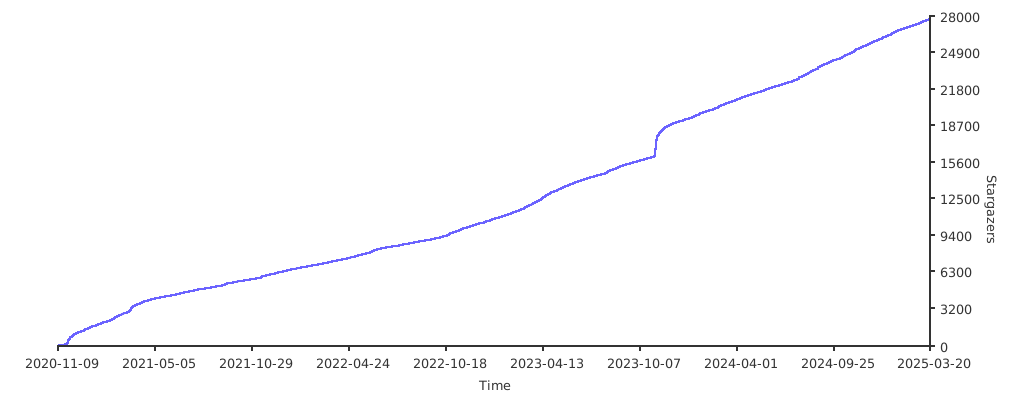
Stargazers over time